The 10-year hit 5.11%. Now comes the data.
Fed talk, PCE on Wednesday, jobs on Friday, and a gold count you can check.
Gold opened on Monday at $4,260.
That is about $27 below Friday's close, and it did not hold. By the European morning gold was under $4,200, its lowest since early August, after President Trump rejected Iran's proposal to reopen the Strait of Hormuz.
Last week
The high of the week came first: $4,387.51, as trading opened on Sunday night. Gold did not see it again. On Monday, Chicago Fed President Austan Goolsbee said that if demand overheats, "there is no ambiguity about how the Fed needs to respond." Oil fell 3.4% to about $100 as more Saudi oil moved through Hormuz, and stocks rallied.
Wednesday did the damage. S&P Global's flash PMI came in at 58.4, the highest since July 2021, with input costs the highest since October 2022. The 10-year Treasury yield rose to 5.11%, its highest since 2007, and the odds of an October hike jumped. Fed Governor Michael Barr said "further policy adjustments are likely to be needed." Gold fell 1.6% and closed under $4,300.
On Thursday two more Fed officials said the same thing in their own words. New York's John Williams said another hike "may be appropriate by the end of the year." Philadelphia's Anna Paulson said "some modest further tightening may be warranted." The dollar held near a two-month high and gold touched $4,244.63, the low of the week. Trump hosted Xi the same day. The trade truce now runs to 10 January, and critical minerals, on the agenda going in, came out with no new deal.
On Friday gold won a little back. Brent fell 2.1% as US and Iranian negotiators explored a phased way out of the war, and gold closed at $4,287, down 2.1% on the week. That is more than twice what it gained the week before.
- Week 21 to 25 Sep
- −2.08%
- Close Fri 25 Sep
- $4,287
- Low Thu 24 Sep
- $4,244.63
- High Mon 21 Sep
- $4,387.51
One number that sat behind the week: 1.75%. World Gold Council modelling says that, all else equal, gold loses roughly that much for every quarter-point rise in the 10-year yield.
Week ahead
Last week the Fed talked. This week the data it keeps pointing to comes out.
- Mon 28 SepFed Vice Chair for Supervision Michelle Bowman and Governor Barr speak. The Board has eleven appearances on its calendar between today and Thursday
- Tue 29 SepJOLTS job openings and Conference Board consumer confidence, 10:00 ET
- Wed 30 SepPCE inflation for August, the Fed's preferred gauge, 8:30 ET. The final estimate of Q2 GDP comes with it. Also the end of the quarter
- Thu 1 OctISM manufacturing, 10:00 ET. China's National Day holiday begins, and the Shanghai Gold Exchange stays closed until Thu 8 Oct
- Fri 2 OctThe September jobs report, 8:30 ET. Economists expect about 90,000 jobs, after 162,000 in August
- Wed 7 OctNext week: minutes of the September Fed meeting
What is still running underneath all of it:
Hormuz is still the oil story. On Friday Iran offered to reopen the Strait within seven days if the US lifted its naval blockade and waived sanctions on Iranian oil, among other conditions. Trump turned it down on Saturday: "They want to make a deal, but it is not the deal that I want to make." He expects talks to resume this week.
Rates are in charge. That is FXStreet's Jasper Osita, who put the problem in one line: "When bonds pay that much, a metal that pays nothing gets harder to own." Markets now price about a 70% chance of an October hike. Our post from Wednesday, below, is the other side of that argument.
The consensus broke. Last week all 16 Wall Street analysts in Kitco's survey expected gold higher, and we said that kind of agreement was worth a little scepticism. This week 5 of 14 expect higher, 4 lower and 5 sideways. Marc Chandler says gold "needs to rise above $4400 to be anything noteworthy." Osita calls $4,200 "the eight-week floor that broke today" and names $4,130 and $4,000 as the next levels down.
From Goldfish
On Wednesday, the day the 10-year hit its 2007 high, we looked at who sells gold into a hike and who buys.
The Fed raised rates on 16 Sep, its first hike since 2023. Gold hit its low of the week that afternoon, $4,261.80, and closed Friday at $4,377.
A hike is supposed to push buyers out of gold. Through the last cycle's 11 hikes to 5.5%, central banks bought more than 1,000 tonnes a year anyway.
The run-up to this cycle looked the same. In Q2 2026, as rate expectations rose, gold ETFs sold 45 tonnes and central banks bought 289.
→ Their strongest Q2 on record.
And in the World Gold Council's 2026 survey, a record 45% of central banks said they plan to add gold over the next 12 months.
A new hike cycle changes what cash pays. The last one didn't change what central banks buy, and by their own account this one likely won't either.
 Read on X
On Monday, the people who buy gold a coin at a time.
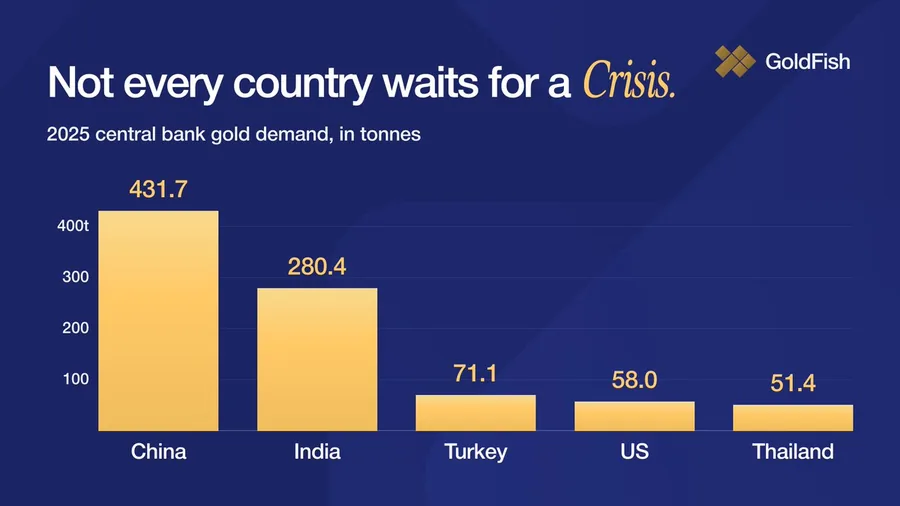
Not every country waits for a crisis to start buying gold.
Global bar and coin demand reached a 12-year high in 2025, according to the World Gold Council.
Higher prices didn't put buyers off. The rally itself helped bring them in.
If the same habits hold through Q4, 2026 could close as the strongest year yet for this kind of buying.
 Read on X
One last thing
China's gold count is disputed. Ours is public.
Goldman Sachs thinks China's central bank bought 35 tonnes of gold in July, about 75% more than it reported. BMO thinks China may already hold more than 5,200 tonnes, over double the official figure. Both banks think the published number is too low.
The count behind $GGBR is public. The GGBR Trust holds 1,000,000 troy ounces of in-situ gold from the Happy 2 Mine claims, documented in geological reports, and every token holder is a beneficiary. The collateral page shows the reserve and the standard it was verified to.
That's the week. The next briefing lands on Monday.
Sent as The Goldfish Briefing, issue 6, on 28 Sep 2026.