29,000 jobs, and the 10-year still hit 5.31%
Hike odds went from 70% to 22%, central banks kept buying, and the Fed minutes land Wednesday.
Gold opened on Monday at $4,144.
That is a dollar above Friday's close, at the end of a week in which the odds of an October Fed hike fell from about 70% to about 22% and the 10-year Treasury yield kept rising anyway. This morning it was up about 1%, near $4,170.
Last week
Monday did most of the damage. President Trump turned down Iran's proposal to reopen the Strait of Hormuz, oil jumped more than $4 before word of Qatari mediation calmed it, and markets priced about a 70% chance of an October hike. Gold fell 4% that day and never got back to where it started the week.
On Tuesday consumer confidence fell to 81.9, the lowest since 2014, and New York Fed President John Williams said there was "no need for urgency," though one more hike "may be appropriate late this year." On Wednesday PCE inflation for August came in at 3.4%, with core at 3.0%. On Friday the September jobs report showed 29,000 new jobs against about 90,000 expected, and July and August were revised down by a combined 60,000. By the evening, the odds of an October hike were about 22%.
Yields didn't come down with the odds: the 10-year closed at 5.28% on Friday and 5.31% on Monday, its highest close since 2002, and StoneX's Daniel Pavilonis doesn't think "the coast is clear for metals to move higher again until we really see a break of yields." Gold closed the week at $4,142.96, down 3.4%.
- Week 28 Sep to 2 Oct
- −3.37%
- Close Fri 2 Oct
- $4,143
- Low Mon 28 Sep
- $4,110.95
- High Mon 28 Sep
- $4,280.56
One number that sat behind the week: 70 tonnes. The World Gold Council says the world's gold ETFs took in more than that in September, a month in which gold fell more than 8%. Central banks, in figures the WGC published today, reported another 39 tonnes of net buying for August, with China adding 20 tonnes, its 22nd month in a row.
Week ahead
Last week the jobs data came in weak. This week the Fed publishes its own record of September, and China's gold market comes back from a week off.
- Tue 6 OctThe LBMA/LPPM precious metals conference closes in Sorrento. Fed Vice Chair for Supervision Michelle Bowman speaks at 10:45 ET
- Wed 7 OctMinutes of the September Fed meeting, 2:00 ET, the meeting that raised rates to 3.75% to 4.00%. India's central bank decides the same morning, and SBI Research and Nomura expect a quarter-point hike. China's September reserve data, with the PBoC's gold, is normally out on the 7th
- Thu 8 OctThe Shanghai Gold Exchange reopens after the National Day holiday. Fed Governor Christopher Waller speaks on the economic outlook in Istanbul at 4:30 ET, and jobless claims are out at 8:30 ET
- Fri 9 OctUniversity of Michigan consumer sentiment, first October estimate, 10:00 ET. September's final reading was 48.1, with year-ahead inflation expectations at 4.6%
- Mon 12 OctColumbus Day. The US bond market is closed
- Wed 14 OctNext week: September CPI, 8:30 ET
What is still running underneath all of it:
The hike moved to December. Futures now put an 80% chance on the Fed holding in October, up from 30% a week earlier, but they still price a full quarter-point hike in December. Dallas Fed President Lorie Logan said on Thursday that rates need to rise "an additional 50 basis points or more."
Hormuz is still shut. Iran's parliament speaker and top negotiator, Mohammad Bagher Ghalibaf, said on Sunday that "the Strait of Hormuz will not open until our seven conditions based on the Islamabad memorandum are met." Washington has sent "some proposals through a mediator," and Brent settled at $100.32 on Monday.
The analysts turned. On 18 Sep all 16 Wall Street analysts in Kitco's survey expected gold higher. On 25 Sep it was 5 of 14, and on Friday it was 3 of 13, with 6 expecting lower. Marc Chandler says "a move above the $4280-$4300 area would boost confidence that a low is in place." Jeff Toshima, formerly the World Gold Council's Tokyo director, expects "strong buying interest from central banks and long-term investors on dips toward $4000."
From Goldfish
On Friday, the day of the jobs report, we looked at why gold funds kept buying with the 10-year above 5%.
Gold is still competing for capital with yields above 5%
But investors aren't always looking for the highest return.
Yield-paying assets compound capital in strong markets, while gold is held as a hedge against risk and loss in drawdowns.
That's why investors hold both, and their gold holdings are still growing. Gold ETFs bought for five straight sessions and now hold the most gold since August 2022.
Hard to say 5% yields are pulling investors out of gold when the funds are still adding to it.
 Read on X
On Wednesday, why higher prices haven't brought much more gold out of the ground. It was our most-read post of the week.
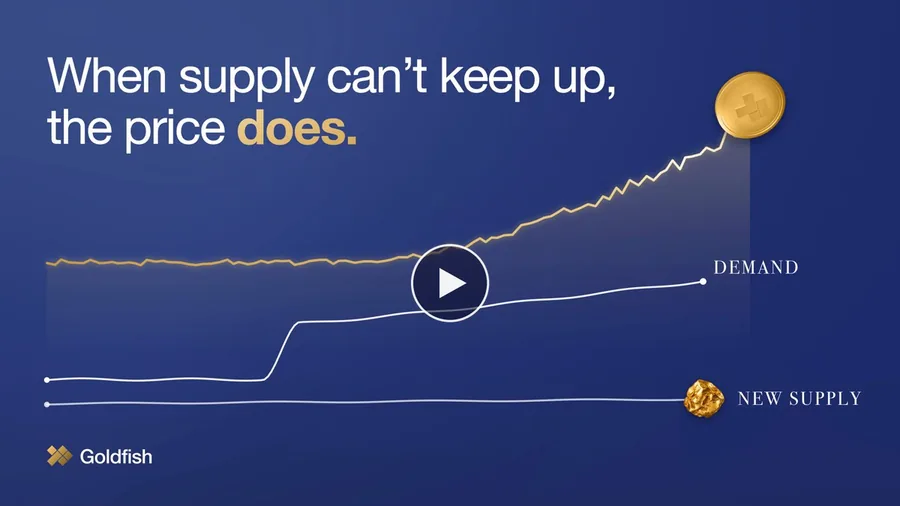
Gold averaged 37% more in Q2 2026 than a year earlier, and the world's mines could only produce 2% more.
Miners have every reason to dig more at these prices, but S&P Global puts the average gold mine at about 15 years from discovery to production.
Still only a modest rise in supply is expected this year.
Usually, a stake in gold that's still in the ground means backing a mine project and waiting out those years.
The in-situ gold behind $GGBR has already been found and documented, so you get the exposure without the wait.
 Read on X
One last thing
Know someone curious about tokenized gold?
If you know someone who wants to learn more about tokenized gold, forward them this email. The sign-up page below gets them the next one, every Monday.
That's the week. The next briefing lands on Monday.
Sent as The Goldfish Briefing, issue 7, on 6 Oct 2026.